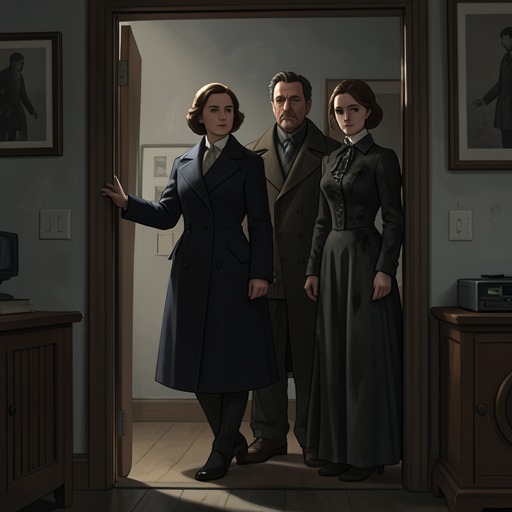
Jarl van Hoother
Finnegans WakeJarl van Hoother is the lord at the center of a brief, repeatedly patterned tale in which the prankquean visits his home three times, asks a question that changes from one pea of porter to two and then three, and carries away a child before his final intervention ends the contest. He appears as both a domestic figure and an imposing public authority: first keeping to his lamphouse, then pursuing the prankquean, and finally emerging fully dressed to command her to stop. The episode’s changing children, repeated rain, and rising count make the encounter a miniature of the book’s recurrent transformations and returns.
Identity and Setting
The tale places Jarl van Hoother in an old landscape where Adam is digging and his “madameen” is spinning. He lives in a high lamphouse within a home described at once as a castle and an earthenhouse, and also as an inn with a bar and cellar. This shifting domestic setting makes him less a narrowly realistic lord than a figure who occupies overlapping roles: household master, keeper of an inn, and ruler within a story-world that blends mythic beginnings with everyday details.
At his home are two “jiminies,” Tristopher and Hilary, and a dummy. Their place in the household changes across the tale: they are first kicking the dummy on the floor, later described below Jarl van Hoother as infants, and eventually appear as Toughertrees and the dummy. The unstable names and stages of childhood prevent the family tableau from settling into a single fixed arrangement. The story instead treats kinship and age as elements that can be reshuffled as it repeats.
The Three Visits
The prankquean first comes to the keep of Jarl van Hoother’s inn, makes a “rosy one,” and asks why she looks like a “poss of porterpease.” Jarl van Hoother answers with a command to shut. She takes Tristopher and runs west; Jarl van Hoother follows, calling for her to stop and return. She rejects the likelihood of that outcome. The first exchange establishes the recurring terms: an arrival, a question, a refusal, and the removal of a child.
After a long journey of forty years, the prankquean returns with the child. Jarl van Hoother is now at the bar, with his heels in the cellar malt, while Hilary and the dummy are below. The prankquean repeats her gesture and asks why she looks like two peas of porter. Jarl van Hoother again tells her to shut. This time she sets one child down and takes another, heading toward Woeman’s Land. He again calls after her, but she answers more positively than before. The plot’s count has risen, but its central exchange remains recognizable: the visit revises the earlier scene without resolving it.
A further return brings the prankquean back with Larryhill beneath her covering. Jarl van Hoother is by the pantry, and the children and dummy are again below, now described as in a later infancy. The prankquean asks why she looks like three peas of porter. At this third challenge, the repeated contest reaches its limit. Rather than simply call after her, Jarl van Hoother comes out through the opened archway of his three-shuttered castles. The sequence moves from one pea to two and three, and from passive position to open confrontation.
Authority and Resolution
For his decisive appearance, Jarl van Hoother is presented in an elaborate assortment of civic and martial clothing, including a broad hat, collar, gloves, breeches, and a bandolier. The description magnifies his authority through costume and accumulated titles, depicting him as “the old terror of the dames.” He puts a hand to his weapon and orders the prankquean to close up shop. The scene’s decisive action is a reversal: the earlier commands had not prevented the child’s removal, but now Jarl van Hoother physically emerges to assert control at the threshold.
The shutter closes with an immense thunder-like word, after which everyone drinks freely. The conclusion calls the episode the first “peace” in a world of verbal conflict and assigns the aftermath its own compact order: the prankquean keeps her dummyship, the jiminies keep the peace, and Jarl van Hoother gets the wind up. His success is therefore not a simple restoration of the household’s earlier state. The tale ends by distributing roles among its participants and turning the clash into a civic settlement.
Repetition and Narrative Form
The episode’s structure is built from recurrence with variation. The prankquean returns after successive intervals, while her question advances numerically and the household’s children and their ages change. Jarl van Hoother’s responses also shift: he first answers from inside the house and pursues her, but in the third encounter he appears at the archway and stops the pattern. Repetition does not reproduce an identical scene; each return alters the people, setting, and balance of power.
The telling itself is as unstable as the action. Jarl van Hoother’s name appears in variant form, and the prose mixes dialects, invented compounds, allusions, and transformations of familiar expressions. Elsewhere, the book presents a many-sided written record whose personalities and traits coalesce into one figure; this helps explain why the Jarl’s little domestic contest can carry the force of a recurring pattern rather than remain a self-contained anecdote. Its repeated visits echo the wider narrative’s return to falls, contests, and renewed beginnings, while its escalating count gives that cyclical motion a concrete shape.